Kitchen · Buying Guide
Best Cutting Board (2026): 8 Picks for Raw Meat, Knives and Holiday Prep
Warped, smelly board and Thanksgiving coming? These 8 cutting boards cover composite, plastic, bamboo, maple, teak and walnut, plus a plain-English wood vs plastic guide, raw-meat safety and care tips.


This guide is research-based; products were not tested hands-on.
Two weeks out from Thanksgiving, your cutting board is about to get more work than it has all year. If yours is warped, stained, smells faintly of last week's garlic, or has knife grooves deep enough to make you wonder what's living in them, this is a good time to replace it. Choosing the best cutting board has also gotten more confusing. Headlines about plastic boards and microplastics, the push toward wood and bamboo, and the titanium boards all over social media can leave you unsure what to buy. This guide sorts it out. These are researched recommendations based on verified listings, manufacturer guidance, and general food-safety advice, not hands-on test results.
As an Amazon Associate, ReviewDeal earns from qualifying purchases.
Below you'll find eight picks:
A best-overall composite board
A plastic board for raw meat and poultry
A budget-friendly three-board set
A bamboo board
An heirloom maple board
A big teak board for carving the turkey
A splurge end-grain walnut board
A plastic-free everyday wood board
Because the real question is usually "which material?", there's also a plain-English material guide. You'll find a side-by-side comparison table and a FAQ covering raw chicken, bamboo, titanium and dishwashers too.
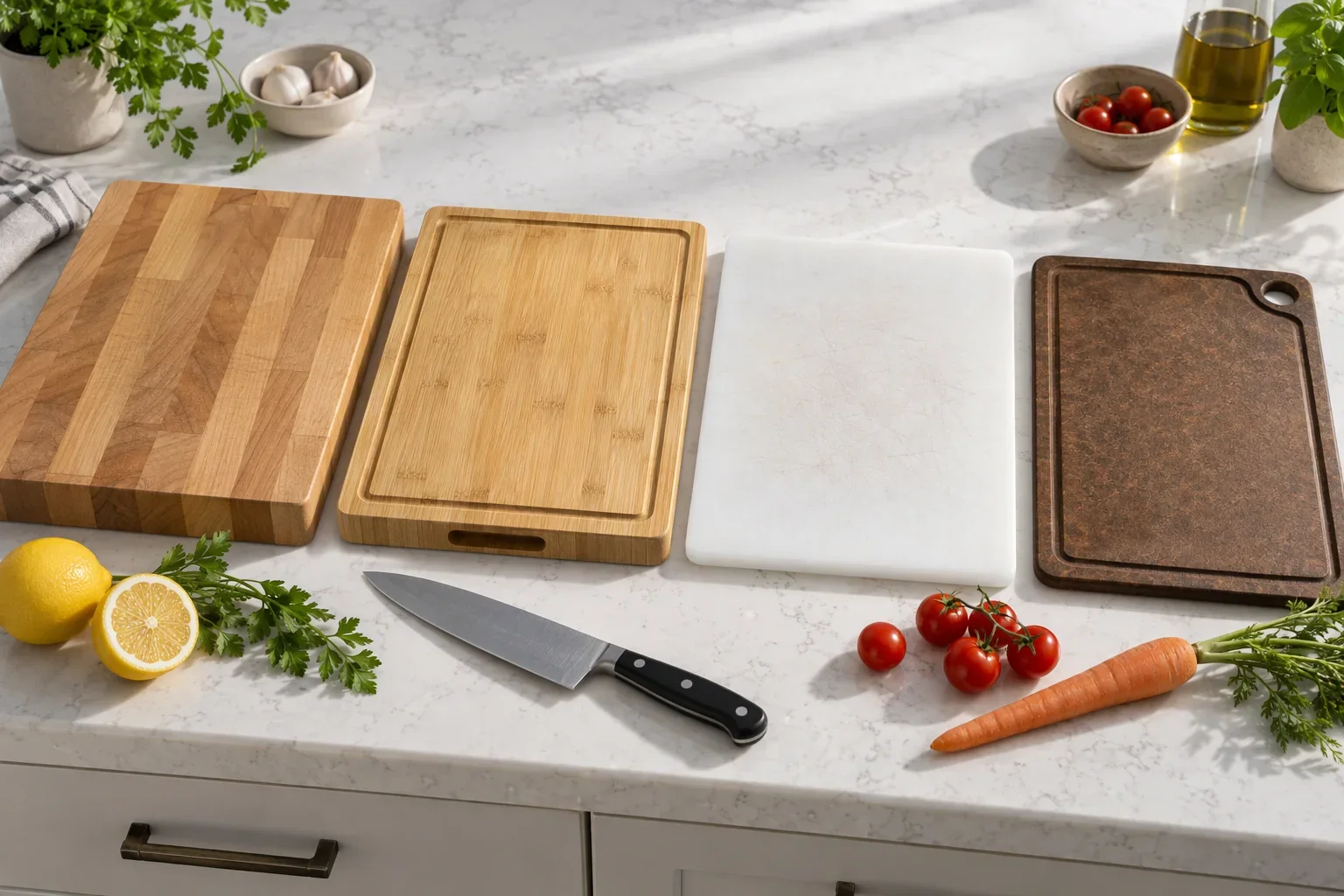
Quick Picks: The Best Cutting Board for Every Kitchen Job
Best overall: Epicurean All-In-One Cutting Board, 14.5" x 11.25": a thin, light, dishwasher-safe composite board with non-slip feet and a juice groove that handles nearly everything.
Best plastic board for raw meat and poultry: OXO Good Grips Plastic Utility Cutting Board: a nonporous, dishwasher-safe board with a drip-catcher, easy-pour corners and non-slip feet, made to be your dedicated raw-protein board.
Best budget set: Gorilla Grip Original Reversible Cutting Board Set: three dishwasher-safe sizes with rubber borders, so you can separate meat from produce without spending much.
Best bamboo board: Royal Craft Wood Bamboo Cutting Board, 18" x 12": a roomy, budget-friendly natural board that flips over for serving cheese and fruit.
Best heirloom maple board: John Boos R-Board Maple Cutting Board, 20" x 15" (R03): a 1.5-inch-thick hard maple workhorse you can oil and keep for years.
Best for carving the turkey: Teakhaus Edge-Grain Teak Carving Board, 20" x 15": a big board with a deep juice canal and a clean reverse side for presentation.
Best splurge (end grain) and best gift: Sonder Los Angeles Alfred End Grain Walnut Cutting Board: a gift-boxed walnut showpiece with sorting wells that also works for charcuterie.
Best plastic-free everyday board: Caraway Wood Cutting Board, Medium 14" x 10": an FSC-certified birch board with a mineral oil and wax finish for daily chopping.
Best Cutting Board Material: Wood vs Plastic vs Bamboo vs Composite
The material you pick decides almost everything else: how your knives hold up, whether the board goes in the dishwasher, and how much care it needs. Here is the quick version.
Material | Kind to knives? | Dishwasher safe? | Upkeep | Best for |
|---|---|---|---|---|
Hardwood (edge grain) | Yes, gentle on edges | No | Hand wash, dry well, oil about monthly | Everyday prep, bread, carving, serving |
Hardwood (end grain) | Very gentle; hides knife marks | No | Hand wash, oil more often; heavier | Heavy chopping, knife lovers, showpiece boards |
Bamboo | Fair; harder than maple or walnut | No | Hand wash, occasional oiling | Affordable natural boards, serving |
Plastic | Good | Usually yes | Low; replace once deeply grooved | Raw meat, poultry and seafood |
Wood-fiber composite | Fairly; firmer than wood, gentler than glass or stone | Usually yes | Low | All-purpose prep, including raw proteins |
Glass / stone / titanium | No; dulls or rolls edges quickly | Often; check the maker | Low, but slippery and noisy | Serving and thawing, not chopping |
The wood vs plastic cutting board debate, in plain English. General food-safety guidance from the USDA says both wood and nonporous boards like plastic can be used for raw meat. The habits matter more than the material: keep a separate board for raw proteins, wash in hot soapy water after every use, and replace boards with deep grooves. Plastic's big advantage is the dishwasher. Its drawback is that knives score it over time. Recent research has also found that cutting on plastic boards can release tiny microplastic particles into food. How much that matters for health is still being studied. If you'd like to cut down on plastic, a wood or composite board for produce and bread is an easy change. Wood is also kinder to knife edges.
What about titanium? Titanium boards are trending on social media because they're nonporous, look sleek and wipe clean easily. The trade-off is hardness. Titanium is far harder than wood or plastic, and many cooks find these boards tough on knife edges, noisy and slippery under a blade. So, are titanium cutting boards good? They work well as a serving or thawing surface. They aren't a great choice for everyday chopping.
The simple fix: a two-board (or three-board) system. Most kitchens are well covered with:
One dishwasher-safe board (plastic or composite) for raw meat, poultry and seafood
One wood or composite board for produce and bread
One large carving board for holiday roasts
For the biggest holiday jobs, like shredding a mountain of cheese, slicing potatoes for a gratin or making pie crust, a food processor saves your board and your wrists.
How We Chose
ReviewDeal did not hands-on test these boards. Our picks are based on:
Verified Amazon listings and current availability
Manufacturer specs and care instructions
The material trade-offs that kitchen roundups and food-safety guidance broadly agree on
Practical details like size, weight, non-slip feet, juice grooves and how much upkeep each board needs
A spread of materials and budgets, from budget-friendly plastic sets to splurge-worthy walnut
We left out glass, marble and metal boards for everyday chopping because they are hard on knives. We also skipped listings that weren't reliably in stock.
Where we mention star ratings, they are as of the time of writing. Rating counts change constantly and can be pooled across size or color variations.
Cutting Boards Compared
Model | Material | Size (as listed) | Dishwasher safe? | Standout feature | Shop |
|---|---|---|---|---|---|
Epicurean All-In-One | Wood-fiber composite | 14.5 x 11.25 in; 1/4 in thick (per Epicurean) | Yes | Heat resistant to 350°F; doubles as a trivet | |
OXO Good Grips Utility | Plastic | 10.39 x 14.78 in | Yes | Drip-catcher, easy-pour corners, non-slip feet | |
Gorilla Grip 3-Piece Set | Plastic | 16 x 11.2, 13.8 x 9.6 and 11.8 x 8 in | Yes | Three sizes with rubber borders | |
Royal Craft Wood Bamboo | Bamboo | 18 x 12 in | No | Side handles; reversible for serving | |
John Boos R03 | Hard rock maple (edge grain) | 20 x 15 x 1.5 in | No | Thick, reversible, recessed finger grips | |
Teakhaus Carving Board | Teak (edge grain) | 20 x 15 x 1.5 in | No | Deep juice canal; arrives pre-oiled | |
Sonder LA Alfred | Walnut (end grain) | 17 x 13 x 1.5 in | No | Three sorting wells; gift box | |
Caraway Wood, Medium | Birch | 14 x 10 in | No | Plastic-free mineral oil and wax finish (per Caraway) |
Our 8 Cutting Board Picks, Reviewed
1. Epicurean All-In-One Cutting Board: Best Overall
Best for: anyone who wants one easy-care board for most daily prep, raw chicken included, without plastic.
This is the low-maintenance middle ground many cooks are looking for. It's made of wood fiber pressed into a nonporous sheet. That means it goes in the dishwasher like plastic, but it doesn't need oiling and it's thin enough to slide into a narrow cabinet. Non-slip feet keep it from skating across the counter, and the juice groove catches drips from tomatoes or a roast chicken.
Epicurean says knives will lightly score the surface, and it frames that as a sign the board is protecting your edge.
Key features:
Wood-fiber composite that Epicurean calls a modified natural material; lightweight, durable, nonporous and knife friendly, per the brand
Heat resistant to 350°F (175°C), so it can double as a trivet
Non-slip corner feet, a generous juice groove, a dual-sided design and a built-in thumb hole for storage
Dishwasher safe; NSF certified per Epicurean's site; 1/4 inch thick per Epicurean
Made in the USA from wood fiber harvested under North American sustainable forestry standards; Amazon highlights it as "microplastics free"
Epicurean lists a lifetime warranty on its site (confirm the terms before you buy); also sold in sizes from 10 x 7 up to 19.5 x 14.5 inches
4.4 stars from about 3,000 ratings at the time of writing
Pros
Dishwasher safe and nonporous, so it works for raw proteins
Thin, light and easy to store
Stays put on the counter and catches juices
Doubles as a trivet
Cons
Firmer and a bit louder to cut on than solid wood
At 14.5 x 11.25 inches, it's too small for a big turkey
The natural color darkens into a patina over time (Epicurean says this doesn't affect performance)
Who should skip it: cooks who love the soft, quiet feel of chopping on thick wood, or anyone who needs one board big enough for holiday carving.
2. OXO Good Grips Plastic Utility Cutting Board: Best Plastic Board for Raw Meat and Poultry
Best for: a dedicated, dishwasher-safe board for raw chicken, turkey, meat and seafood.
If you want a board that goes straight into the dishwasher after handling raw poultry, this is a practical choice. It's sized for real prep, at about 10.4 x 14.8 inches. The drip-catcher and easy-pour corners help keep raw juices off the counter, and the non-slip feet keep it steady while you trim. Keep it for raw proteins only, and pair it with a wood or composite board for produce.
Key features:
Large utility size, 10.39 x 14.78 inches; OXO model 8862
Double-sided, nonporous surfaces that OXO says resist odors and won't dull knife blades
Soft, tapered edges that work as handles
Integrated drip-catcher (juice groove), easy-pour corners and non-slip feet
Dishwasher safe
4.6 stars from about 14,000 ratings at the time of writing (pooled with other OXO board listings)
Pros
Dishwasher safe for easy cleanup after raw meat
Juice groove and pour corners contain the mess
Non-slip feet and comfortable edges
Budget-friendly
Cons
Knives score plastic over time; replace it once the grooves get deep
Cutting on plastic can shed microplastic particles
Utilitarian look, so it won't double as a serving board
Who should skip it: anyone trying to remove plastic from their kitchen. The Epicurean composite is the closest dishwasher-safe alternative.
3. Gorilla Grip Original Reversible Cutting Board Set: Best Budget Set
Best for: setting up a color-coded raw-meat-versus-produce system on a budget.
Three boards in three sizes cover a lot of ground:
The large board handles a chicken or a pile of vegetables
The medium works for weeknight prep
The small one is ideal for a lemon, a few garlic cloves or a quick snack
The set comes in several colors, so you can buy one color for raw proteins and keep it separate. The rubber border helps the boards grip the counter.
Key features:
Three boards: large 16 x 11.2 in, medium 13.8 x 9.6 in, small 11.8 x 8 in
Each 0.37 inch thick; about 4.25 lb combined
Reversible, with deep juice grooves on one side
Slip-resistant handle and rubber border
Nonporous plastic that Gorilla Grip says won't splinter or peel; BPA free and food grade per the brand
Dishwasher safe; this link is the black set
4.7 stars from about 52,900 ratings at the time of writing (pooled across colors)
Pros
Three useful sizes for a budget-friendly price
Dishwasher safe
Grippy border helps prevent sliding
Color options make separating raw meat simple
Cons
Plastic gets scored and will eventually need replacing
Not pretty enough for serving
Thinner and lighter than a wood block
Who should skip it: anyone who wants a plastic-free kitchen or a board handsome enough to bring to the table.

4. Royal Craft Wood Bamboo Cutting Board: Best Bamboo Board
Best for: a large, budget-friendly natural board that handles both prep and serving.
At 18 x 12 inches, this board gives you real room for holiday chopping. The side handles make it easy to carry to the table, and you can flip it over to set out cheese, fruit or charcuterie. Bamboo is renewable and light, which is a plus at this size.
One honest caveat: bamboo is generally a harder surface than maple or walnut. Even though the brand calls this board knife-friendly, expect to hone or sharpen your knives a little more often.
Key features:
100% natural bamboo, responsibly sourced per the brand; 18 x 12 inches
Deep juice grooves and built-in side handles
Reversible: one side for prep, the other for serving
The brand says the sealed surface resists staining and odors and that its protective finish resists cracking and warping
Hand wash with mild soap and warm water; not dishwasher safe
4.7 stars from about 54,000 ratings at the time of writing
Pros
Big board for the money
Handles and a serving side make it double-duty
Lighter than a hardwood board of similar size
Cons
Harder on knife edges than maple or walnut
Hand wash only, with occasional oiling
Bamboo boards are held together with adhesives
Who should skip it: cooks with prized knives, or anyone who wants dishwasher convenience.
5. John Boos R-Board Maple Cutting Board (R03): Best Heirloom Maple Board
Best for: someone ready to oil a beautiful board in exchange for a lifetime workhorse.
This is the classic thick maple board, and the kind of board that can live on your counter for years. It's 20 x 15 inches and 1.5 inches thick, so it gives you space to break down a roast, chop a pile of mirepoix and stage ingredients at the same time. It's reversible, which lets you keep one side for onions and garlic and the other for fruit and bread.
Hard maple is known for being kind to knife edges. The trade-off is weight: at about 12 pounds, it's a board you leave out, not one you move around.
Key features:
Solid Northern hard rock maple, NSF certified per Boos; edge-grain construction
20 x 15 x 1.5 inches; Amazon lists it at about 12 lb
Reversible, with recessed finger grips, an oil finish and a level cutting surface
Made in the USA with domestic and imported materials, per Boos
Hand wash only; Boos recommends its Mystery Oil and Board Cream (sold separately)
Available in three sizes (this link is 20 x 15); 1-year guarantee against defects in workmanship and material, per the listing
Pros
Gentle on knives
Roomy and stable for big prep jobs
Reversible for separating tasks
Built to last with basic care
Cons
Heavy, and may be awkward to wash in a small sink
No juice groove
Needs regular oiling, and it's a splurge
Who should skip it: anyone with a small sink, limited counter space or no interest in oiling a board.
6. Teakhaus Edge-Grain Teak Carving Board: Best for Carving the Thanksgiving Turkey
Best for: carving a turkey, ham or roast at the table without flooding the counter.
This board's size (20 x 15 inches) and deep juice canal are its main strengths. Once your meat thermometer tells you the bird is done and it has rested, you can carve right on the groove side. Flip it over, and the clean side works for presentation.
Teak's natural oils help it resist moisture, according to the brand. It also arrives pre-oiled, which helps if the holiday is coming up fast. Some knife enthusiasts note that teak contains natural silica, which can be slightly harder on edges than maple.
Key features:
100% FSC-certified teak, edge grain; 20 x 15 x 1.5 inches, about 12 lb
Deep juice groove ("juice canal") to catch drippings
Reversible, with a clean side for presentation and the other side for prep
Hand grips; arrives pre-oiled
Teakhaus says teak's natural oils make it moisture resistant and kind to knives
Hand wash only; not dishwasher safe
Teakhaus suggests applying mineral oil 2–3 times per month (oil sold separately)
Pros
Deep groove made for juicy roasts
Big enough for a small-to-medium turkey
Attractive enough to bring to the table
Pre-oiled and ready to use
Cons
Heavy at about 12 lb
Hand wash only, with frequent oiling
The groove side is less convenient for everyday chopping
Who should skip it: anyone who rarely roasts or carves big cuts and has limited storage.
7. Sonder Los Angeles Alfred End Grain Walnut Cutting Board: Best Splurge (End Grain) and Best Gift
Best for: a showpiece board for serious chopping, charcuterie and gifting.
End grain is the gentlest wood option for knives, and dark walnut is hard to beat for looks. Sonder adds three built-in sorting wells, which are handy for corralling prepped ingredients or holding olives, nuts and jam on a party board. The juice groove holds about 3.5 fluid ounces.
It arrives in a gift box, so it's an easy host or holiday present. Plan on more frequent oiling, as with any end-grain board.
Key features:
American black walnut, sustainably sourced per Sonder; 17 x 13 x 1.5 inches
End-grain construction that Sonder says protects knives and "self-heals" as the fibers close back up
Handcrafted in small batches in the USA
Deep juice groove (about 3.5 fl oz) and three built-in sorting compartments
Removable rubber feet, finger grips and gift box
Hand wash only with mild soap; no dishwasher, no soaking
Sonder says to oil it every 2–3 weeks and to avoid storing it next to the stove; replacement for manufacturing defects per Sonder's warranty note
Pros
Very gentle on knife edges
Gorgeous enough for serving guests
Sorting wells add real versatility
Gift-ready packaging
Cons
A splurge
End grain needs more frequent oiling
Must be kept away from heat, and hand washed only
Who should skip it: anyone who wants a low-maintenance board or a dedicated board for raw meat they can toss in the dishwasher.
8. Caraway Wood Cutting Board, Medium: Best Plastic-Free Everyday Board
Best for: daily chopping on a simple, plastic-free wood board that looks good left out.
At 14 x 10 inches, this birch board fits weeknight jobs: an onion, a few peppers, a loaf of bread. The recessed indent keeps chopped food from scattering. Caraway says it can be used for raw proteins as long as it's washed thoroughly afterward and oiled regularly. The brand also suggests dedicating one side to specific tasks.
Key features:
FSC-certified birch wood with a food-safe mineral oil and wax finish
No plastics or BPA, per Caraway
Double-sided, with a recessed indent to corral chopped food
Comes in small (10 x 7), medium (14 x 10) and large (17 x 12) sizes; this link is the medium
Hand wash and air dry upright
Pros
Plastic-free materials and finish
Manageable size and weight for daily use
Clean, modern look
Cons
Too small for a turkey or a large roast
Hand wash only, with regular oiling
Fewer ratings (4.2 stars from about 560 at the time of writing) than the big sellers
Who should skip it: anyone who wants a single board that's both dishwasher safe and big enough for holiday carving.
Cutting Board Buying Guide: What Actually Matters
Material and your knives
If you're after the best cutting board for knives, look at hardwood:
End grain is gentlest, since the knife slips between the wood fibers rather than slicing across them.
Edge grain is a little firmer, very durable and usually less expensive.
Composite and plastic fall in the middle.
Bamboo is harder than maple or walnut.
Glass, stone and metal dull edges fastest.
Even the gentlest board won't keep an edge forever, so a good knife sharpener is worth having before the holiday rush.
Food safety and raw meat
The USDA's general guidance comes down to a few habits:
Keep one board for raw meat, poultry and seafood, and another for ready-to-eat foods and produce.
Wash boards in hot, soapy water after each use.
Put nonporous boards (plastic, composite) through the dishwasher if you like.
To sanitize wood or plastic, the USDA suggests about 1 tablespoon of unscented liquid chlorine bleach per gallon of water. Rinse afterward and let the board air dry.
Replace any board with deep grooves that are hard to clean.
Some studies suggest wood can be less hospitable to bacteria than people assume. Even so, the basics above matter most.
Size, weight and storage
About 15 x 11 inches handles everyday prep.
18 x 12 to 20 x 15 inches gives room for a whole chicken, a roast or a small-to-medium turkey.
Small boards are handy for a lemon or a few garlic cloves.
Before you buy, measure your counter, sink and dishwasher. A 12-pound wood board can be a workout to wash in a small sink.
Grip and juice grooves
Rubber feet or grippy edges stop a board from sliding. If yours has neither, set a damp towel underneath.
Juice grooves are great for carving and juicy fruit. Some cooks find them annoying for chopping vegetables, though, so reversible boards with one flat side give you the most flexibility.
Care: how to clean a wooden cutting board and oil it
Scrape off food, then scrub with hot, soapy water. Never soak a wood board or put it in the dishwasher.
After raw meat, rinse the board, then sanitize it with a diluted bleach solution (or a vinegar wipe) and rinse again.
To deodorize, scrub with coarse salt and half a lemon, or with baking soda.
Dry it right away and stand it upright so air reaches both sides.
Oil it with food-grade mineral oil or a board cream or beeswax blend. Do this before first use if it isn't pre-oiled, then roughly once a month or whenever it looks dry. Some brands suggest every 2–3 weeks.
Skip vegetable and olive oil, which can go rancid.
A note on "non-toxic" claims
When people search for the best non toxic cutting board, they usually mean a board with no plastic and a food-safe finish, such as mineral oil or beeswax. There's no single standard definition of "non-toxic" for cutting boards, so treat it as marketing language.
Look for specifics instead: the actual material, the finish the brand discloses, and any certifications the maker lists.
Cutting Board FAQ
Is a wood cutting board better than plastic?
Neither is better in every way. Wood is kinder to knives, looks beautiful and avoids plastic, but it needs hand washing and oiling. Plastic is inexpensive and dishwasher safe, but it scores over time. Many cooks use both: plastic or composite for raw meat, and wood for everything else.
Are plastic cutting boards safe?
Food-safety guidance says plastic boards are fine to use as long as you wash them well and replace them once deeply grooved. Research has found that cutting on plastic can release microplastic particles into food, and the health impact is still being studied. If that concerns you, a composite or wood board is an easy swap.
What is the best cutting board for raw meat?
A nonporous, dishwasher-safe board is the easiest option. A plastic board like the OXO Utility and a composite board like the Epicurean both fit that description. Wood can also be used for raw meat if you wash and sanitize it carefully. Whatever you choose, keep it separate from your produce board.
Are bamboo cutting boards safe, and are they bad for knives?
Are bamboo cutting boards safe? Yes, with the same care as wood: hand wash, dry well and oil occasionally. Bamboo is harder than maple or walnut, so it's generally considered tougher on knife edges. It's also held together with adhesives.
Are titanium cutting boards good?
They're nonporous and easy to clean, but they're much harder than wood or plastic. Many cooks find them hard on knives, noisy and slippery. Use one for serving or thawing rather than daily chopping.
How do you clean a wooden cutting board after raw chicken?
Scrub it with hot, soapy water and rinse. Then sanitize with about 1 tablespoon of unscented bleach per gallon of water, or with a vinegar wipe, and rinse again. Stand it upright to dry completely.
Can wood cutting boards go in the dishwasher?
No. The heat and long soak can warp, crack or dry out wood, and every wood and bamboo board in this guide is labeled hand wash only.
How often should you replace a cutting board?
There's no fixed schedule. Replace plastic boards once deep knife grooves make them hard to clean. Wood boards can last for years with oiling, but retire one if it cracks, warps badly or holds odors that salt and lemon can't remove.
The Bottom Line
You don't need one perfect board. A small system works better:
For raw proteins: a dishwasher-safe board like the Epicurean All-In-One or the OXO Utility
For produce and bread: a wood board like the Caraway or the John Boos
For the turkey: a big carving board like the Teakhaus
On a tight budget: the Gorilla Grip set covers several jobs at once
For a gift, or a board that doubles as a charcuterie platter: the Sonder LA Alfred
Pick what fits your kitchen, oil anything wooden before the big day, and enjoy the holiday cooking.
By Kiyomi Dyme
Keep reading.

Best Food Processor (2026): 8 Picks for Holiday Prep, Chopping and Pie Crust
Chopping onions for stuffing, shredding cheese for casseroles, pulsing pie crust: these 8 food processors cover big-batch 14-cup models, mid-size picks for small kitchens, a blender combo and easy mini choppers.
Read Guide
Best Air Fryer (2026): 8 Picks for Crispy Weeknight Dinners and Holiday Sides
Want crispy dinners without heating the whole kitchen? These 8 air fryers cover families, holiday sides, small kitchens, glass cooking, easy cleanup and cooking for one or two.
Read Guide
Best Hand Mixer (2026): 8 Picks for Holiday Baking, Cookie Dough and Whipped Cream
The best hand mixer for holiday baking: 8 corded and cordless picks for cookie dough, whipped cream and mashed potatoes, from budget to splurge.
Read Guide