Kitchen · Buying Guide
Best Knife Sharpener (2026): 8 Easy Picks for Dull Kitchen Knives
The best knife sharpener for your kitchen: 8 easy picks, from electric and manual to whetstones, rolling sharpeners and honing rods, plus angle tips.

This guide is research-based; products were not tested hands-on.
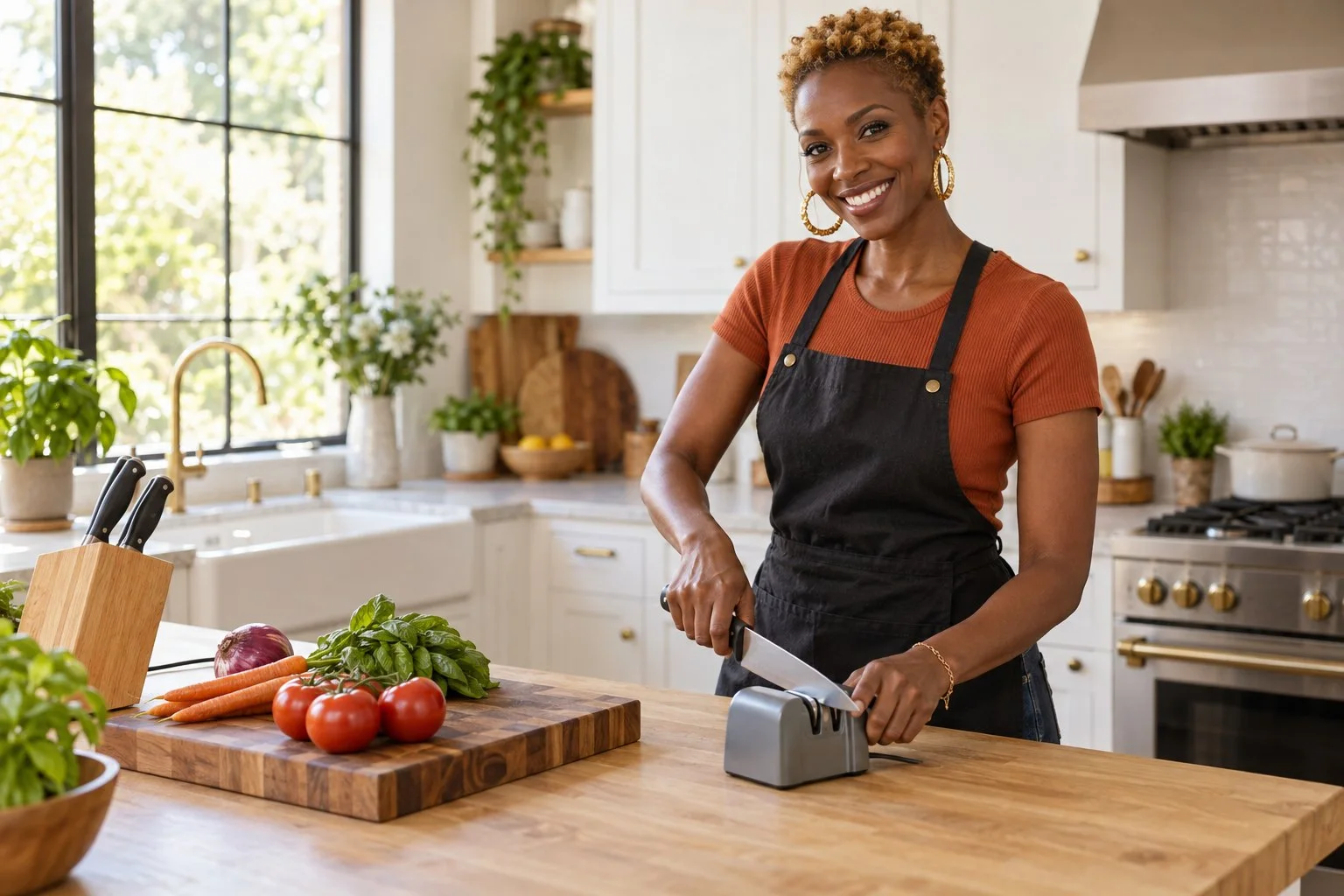
If your tomatoes squash instead of slicing, your onions skate across the board and you're practically sawing through chicken thighs and butternut squash, you probably don't need new knives. You need the best knife sharpener for the knives you already own. A dull edge makes every prep job slower and more tiring. It's also riskier: a blade that won't bite tends to slip, and slipping is when fingers get nicked. With Thanksgiving carving and big-batch holiday cooking coming up, now is the time to get your knives back into shape. If whetstones, angles and talk of "burrs" have kept you from starting, this guide is for you. We researched these picks using Amazon listing details and specs, general kitchen-knife care guidance and the broad consensus of established review outlets. ReviewDeal did not test them hands-on.
As an Amazon Associate, ReviewDeal earns from qualifying purchases.
Below you'll find eight options that cover every comfort level. There's a set-it-and-forget-it electric model, a budget-friendly electric, a compact manual sharpener that handles both Western and Japanese angles, and a tiny handheld that fits in any drawer. There's also a beginner whetstone kit, a giftable rolling sharpener, a belt system that also does scissors and garden tools, and a honing rod to keep everything sharp between sessions. After the reviews, we explain angles, serrated blades and honing vs sharpening in plain language. Then you can choose with confidence, whether you're chopping onions, carrots and celery for a pot of chili in the slow cooker or carving the holiday roast.

Quick Picks: The Best Knife Sharpener for Every Kitchen
Best overall electric: Chef'sChoice 15XV EdgeSelect Professional Electric Knife Sharpener. Three stages, automatic angle guides and support for straight and serrated blades make it the most foolproof option here.
Best budget-friendly electric: Presto 08810 Professional EverSharp Electric Knife Sharpener. A blade thickness selector and guided slots bring electric convenience at a friendlier price tier.
Best manual for both Western and Japanese knives: Chef'sChoice ProntoPro Diamond Hone 4643. Separate 15-degree and 20-degree guides let you sharpen a mixed knife block without power or guesswork.
Best budget-friendly handheld: AccuSharp Knife and Tool Sharpener. It's tiny, quick and the most-rated pick on this list, which makes it a great fit for everyday knives and small drawers.
Best whetstone for beginners: Sharp Pebble 1000/6000 Whetstone Kit. A dual-grit stone, non-slip base and angle guide give you a gentle on-ramp to stone sharpening.
Best rolling sharpener and best gift: The Original Tumbler Rolling Knife Sharpener. A magnetic angle holder with fixed 15-degree and 20-degree options takes the wobble out of sharpening, and it looks good on a counter.
Best for knives, scissors and garden tools: Work Sharp MK2 Electric Knife and Tool Sharpener. Flexible belts and two speeds handle kitchen knives, serrated blades, scissors and yard tools alike.
Best honing rod for between sharpenings: Work Sharp Kitchen Ceramic Honing Rod. Built-in angle guidance makes quick pre-cooking touch-ups easy and keeps edges keen longer.
Knife Sharpeners Compared
Pick | Type | Angles and blades (per listing) | Best for | Watch out for | Shop |
|---|---|---|---|---|---|
Chef'sChoice 15XV | Electric, 3-stage | Converts 20-degree factory edges to a 15-degree edge (per Chef'sChoice); straight-edge and serrated | Fast, hands-off sharpening of a full knife block | Splurge; bulky; reprofiles knives to 15 degrees | |
Presto 08810 EverSharp | Electric, 3-stage | Blade guides set the angle; thickness selector for thick, medium and thin blades; kitchen and sport knives, including Santoku | Electric convenience on a tighter budget | Not listed for serrated; plastic build; 1-year warranty | |
Chef'sChoice ProntoPro 4643 | Manual pull-through, diamond | 15-degree (Asian-style) and 20-degree (European/American-style) guides; straight-edge and serrated, sports and pocket knives | Mixed Western and Japanese-style collections | More strokes than electric; use the right slot; press lightly | |
AccuSharp 014 | Handheld carbide | Fixed angle; chef's, paring, serrated and fillet knives, cleavers, pocket knives and tools | Tiny drawers, quick fixes, everyday knives | Aggressive on fine or expensive knives; less refined edge | |
Sharp Pebble 1000/6000 | Whetstone kit | Freehand with included angle guide; kitchen and pocket knives, scissors, chisels and more | Learning to sharpen by hand for the finest edge | Learning curve; water and cleanup; needs flattening eventually | |
Tumbler Rolling Sharpener | Rolling with magnetic angle holder | Fixed 15-degree and 20-degree angles; diamond disc to sharpen, steel disc to hone | Beginners, gifting, countertop display | Not listed for serrated; slower on very dull blades | |
Work Sharp MK2 | Electric belt, 2-speed | Edge guide; kitchen, pocket and serrated knives, scissors, axes, garden tools, lawn mower blades | Whole-household sharpening | Learning curve; belts wear out; overkill for a few knives | |
Work Sharp Ceramic Honing Rod | Ceramic honing rod | Built-in angle guidance; chef's, santoku, paring, utility and serrated kitchen knives | Maintaining an edge between sharpenings | Won't fix a truly dull or chipped edge; can break if dropped |
Our Top Knife Sharpener Picks, Reviewed
A quick note on ratings before we get into it: the star averages and rating counts below come from Amazon at the time of writing. Amazon sometimes pools ratings across listing variations, such as colors or bundles, so treat them as a general signal rather than a verdict on one exact model.
1. Chef'sChoice 15XV EdgeSelect: Best Overall Electric
If you want the closest thing to dropping your knives off at a sharpening shop without leaving the house, this is it. The 15XV is a three-stage electric sharpener with spring-loaded angle guides that hold the blade for you. You don't have to think about degrees at all. You just pull the knife through each slot. Chef'sChoice says it converts traditional 20-degree factory edges to its 15-degree "Trizor XV" edge. That's a sharper, more acute profile than many German-style knives ship with. For a lot of home cooks, it's the best electric knife sharpener you can buy if speed and simplicity matter most. It carries a 4.6-star average from roughly 14,400 ratings at the time of writing, and it's an Amazon's Choice pick.
Best for: Busy cooks with a full knife block who want fast, consistent results with almost no learning curve, especially before big holiday prep.
Key features
Three-stage EdgeSelect system. Stages 1 and 2 use 100 percent diamond abrasives to sharpen and hone. Stage 3 is a patented flexible stropping and polishing stage, per the listing.
For straight-edge and serrated blades, with the polishing stage helping on serrated knives (per the listing).
Patented flexible spring angle guides for automatic angle control.
Simple on/off switch. Chef'sChoice says first-time sharpening takes about 1 minute and resharpening about 10 seconds.
About 10 x 4.25 x 4.25 inches and about 4.2 pounds.
3-year limited warranty per the listing.
Pros
Close to foolproof: the guides handle the angle, so there's no wobbling.
Handles serrated knives as well as straight edges.
Very quick once your knives have been converted, according to the brand.
The multi-stage design goes from sharpening to polishing in one machine.
Strong rating volume and a longer warranty than some electric options.
Cons
A splurge compared with the rest of this list.
It reprofiles 20-degree knives to 15 degrees. That's a commitment if you'd rather keep a sturdier edge on heavy German-style knives.
Bulky. You'll need counter or cabinet space for it.
Like all electric sharpeners, it removes more metal than honing does. It also makes motor noise.
Not listed for ceramic knives or single-bevel Japanese knives.
Who should skip it: Cooks with very limited storage, anyone who wants to keep a 20-degree edge on their Western knives, and owners of ceramic or single-bevel Japanese blades.
2. Presto 08810 EverSharp: Best Budget-Friendly Electric
The Presto EverSharp gives you the main perk of electric sharpening, which is letting a motor and guides do the work, at a more approachable price tier. Its standout feature is a blade thickness selector. You set it to thick for hunting knives, medium for chef's and standard kitchen knives, or thin for light blades like fillet and paring knives, and the guides adjust to match. Presto says the guides hold the knife at the right angle for no-guess sharpening. The final wheel is an extra-fine-grit ceramic. Suction-cup feet help keep it planted on the counter. It holds about 4.5 stars from roughly 10,800 ratings at the time of writing.
Best for: Anyone who wants electric convenience for everyday straight-edge kitchen knives without stretching to a premium model.
Key features
Three-stage sharpening system with Sapphirite wheels, per the listing.
Blade thickness selector with thick, medium and thin settings.
Blade guides hold the knife at the angle for you.
Extra-fine-grit ceramic final wheel.
Sharpens kitchen and sport knives, including Santoku knives (per the listing).
Suction-cup feet for stability. 120 volts.
About 5.1 pounds (listing weight) and a 1-year limited warranty.
Pros
A budget-to-mid-range way into electric sharpening.
The thickness selector adds flexibility for different blade styles.
Guided slots take the angle guesswork away.
Suction feet help keep it steady while you work.
Cons
Not listed for serrated blades, so keep your bread knife away from it.
Plastic build.
Shorter warranty than several other picks.
Removes more metal than manual methods and takes counter space.
Who should skip it: Anyone who mainly needs to sharpen serrated knives, and cooks who'd rather invest in a longer warranty.
3. Chef'sChoice ProntoPro 4643: Best Manual for Both Western and Japanese Knives
Lots of kitchens have a German-style chef's knife next to a Japanese-style santoku. If that's yours, this compact manual sharpener solves the "which angle?" headache. It has separate guides for 15-degree edges (Asian-style knives) and 20-degree edges (European and American-style knives). You simply pick the right slot and pull through gently. The wheels are 100 percent diamond abrasive. Chef'sChoice says its CrissCross technology sharpens "into" and "out of" the edge to create a burr-free, arch-shaped edge with "bite." It needs no power, weighs about 8 ounces and slips easily into a drawer. For mixed collections, it's arguably the best manual knife sharpener on this list. It's an Amazon's Choice pick with about 4.4 stars from roughly 6,750 ratings at the time of writing.
It's especially handy for quick weeknight touch-ups. A few gentle strokes before you slice peppers, carrots and chicken for a stir-fry or a rice bowl with your rice cooker can make prep feel noticeably smoother.
Best for: Cooks with a mix of Western and Japanese-style double-bevel knives who want a compact, unplugged sharpener that respects each angle.
Key features
Manual design, no power needed.
Precise angle guides for 15-degree and 20-degree edges.
100 percent diamond abrasive wheels with CrissCross sharpening technology, per Chef'sChoice.
Sharpens straight-edge and serrated knives, plus sports and pocket knives.
Soft Touch handle for a secure grip.
Compact: about 9.25 x 2 x 2 inches and about 8 ounces.
10-year warranty per the listing details.
Pros
Handles both common edge angles in one tool.
Works on serrated knives too.
Small and light enough to live in a drawer.
The longest listed warranty on this list.
No cord, no outlet and no motor noise.
Cons
Takes more strokes and more arm effort than an electric model.
You need to use the correct slot for each knife.
It's a pull-through design, so press lightly. Heavy pressure can be harsh on an edge.
A lower star average than the top-rated picks.
Who should skip it: Anyone who wants fully hands-off sharpening, or anyone with single-bevel Japanese or ceramic knives, which aren't listed.
4. AccuSharp Knife and Tool Sharpener: Best Budget-Friendly Handheld
The AccuSharp is small, bright orange and wildly popular. It has about 4.7 stars from roughly 28,900 ratings at the time of writing, the most of any pick here. It uses diamond-honed tungsten carbide blades that you can reverse to double their life span, per the listing. AccuSharp says it restores most blades in a few strokes, in "about 10 seconds." It works differently from most sharpeners: you lay the knife on a stable counter with the edge facing up, as the instructions describe, and draw the sharpener along the blade. A full-length finger guard sits between your hand and the edge. It's about 8.6 inches long, very lightweight, and you can wash it with soap and water or in the dishwasher.
Best for: Tight kitchens, first apartments, camping kits, vacation rentals and anyone who wants quick fixes for everyday, inexpensive knives.
Key features
Diamond-honed tungsten carbide sharpening blades, reversible to double their life span.
For chef's, paring, serrated and fillet knives and cleavers, plus pocket knives and tools.
Ergonomic handle for right- or left-handed use with a full-length finger guard.
Cleans with soap and water or in the dishwasher.
About 8.6 inches long.
2-year manufacturer warranty per the listing details.
Pros
The most budget-friendly pick and the easiest to store.
Very fast, according to the brand.
Works on serrated knives.
Reversible blades extend its usable life.
Huge rating volume.
Cons
Carbide is aggressive and removes metal quickly. Save it for everyday knives, not fine or expensive Japanese blades.
Fixed angle, so you can't choose 15 or 20 degrees.
Leaves a less refined edge than a stone or the multi-stage picks.
Takes a careful technique: stable counter, edge up and fingers behind the guard.
Who should skip it: Anyone with premium or Japanese-style knives they want to baby, and cooks who want a polished, razor-fine finish.
5. Sharp Pebble 1000/6000 Whetstone Kit: Best Whetstone for Beginners
Whetstones have a reputation for being fussy, and honestly, they do take practice. But they also give you the most control and the finest edge of any method here. This kit is built to lower the intimidation. It has a dual-grit stone: 1000 grit to repair dull or damaged edges, and 6000 grit to polish. It sits on a non-slip bamboo base and comes with an angle guide, an instruction manual and a tips ebook. It's water-based, so there's no honing oil to buy or clean up. Sharp Pebble says the stone stays flat longer than cheap stones. That's the brand's claim, but it's worth knowing that every stone eventually needs flattening. If you've been curious about learning a real skill, it's a strong contender for the best whetstone for beginners. It's the #1 seller in Honing Stones at the time of writing, with about 4.6 stars from roughly 25,700 ratings.
Best for: Curious, patient cooks who want to learn hand sharpening and get the most refined edge on their good knives.
Key features
Dual-grit stone: 1000 grit for sharpening, 6000 grit for polishing.
Non-slip bamboo base, angle guide, instruction manual and tips ebook included.
Water-based, no honing oil needed.
For kitchen knives, pocket knives, scissors, chisels and more, per the listing.
Stone about 7.25 x 2.25 x 1 inches. Kit about 2.1 pounds.
Pros
The most control over your edge of any pick.
Works on any angle you can hold, including both Western and Japanese-style double-bevel knives.
Gentle on metal compared with carbide or aggressive electric stages.
Compact and quiet, with nothing to plug in.
The angle guide and base make the first sessions less nerve-racking.
Cons
A real learning curve, even with the guide.
Slower than electric or pull-through sharpeners.
Needs water and a little cleanup each time.
The stone will eventually need flattening.
Results depend on holding a steady angle. Take the listing's speed claims as the brand's own.
Who should skip it: Anyone who wants sharp knives tonight with zero practice, and anyone who knows they'd rather not get their hands wet.
6. The Original Tumbler Rolling Knife Sharpener: Best Rolling Sharpener and Best Gift
Rolling sharpeners are the newer middle ground between whetstones and pull-through gadgets, and the Tumbler is the one most people picture. You secure the blade on a magnetic holder that offers fixed 15-degree and 20-degree angles. Then you roll the wooden sharpener back and forth along the edge. One side has a diamond-plated disc to sharpen. The other has a stainless steel "helix" disc to hone and refine. Because the magnet holds the angle, there's no wobble to worry about, which is the part that scares most people off whetstones. Tumbler says beginners can use it and positions it as an alternative to messy whetstones. The set weighs about 1.4 pounds and has a wood finish that looks lovely on a counter. That makes it a very giftable choice for a host, a friend or yourself. It has about 4.4 stars from roughly 3,470 ratings at the time of writing.
Best for: Beginners who want guided angles without water or noise, and anyone shopping for a thoughtful holiday gift for a home cook.
Key features
Diamond-plated disc to sharpen and stainless steel "helix" disc to hone and refine.
Magnetic angle holder with fixed 15-degree and 20-degree angles.
Set includes the rolling sharpener and the magnetic knife holder.
Wood finish. About 1.4 pounds.
Pros
Guided angles for both Western and Japanese-style knives.
Quiet and mess-free compared with a whetstone.
Easy, intuitive motion that suits nervous first-timers.
Attractive enough to leave out, and great as a gift.
Cons
Not listed for serrated knives.
Slower on very dull or chipped blades than coarse electric stages.
Small knives and short blades can be fiddly on the magnet.
A lower star average than several other picks.
Who should skip it: Anyone who mainly needs to fix badly damaged blades fast, or who needs serrated support in one tool.
7. Work Sharp MK2 Electric Knife and Tool Sharpener: Best for Knives, Scissors and Garden Tools
The MK2 is less a kitchen gadget and more a whole-household sharpening station. Instead of fixed wheels, it uses flexible abrasive belts that conform to the edge. Per the listing, that lets it handle kitchen and pocket knives, serrated knives, scissors, axes, garden tools and even lawn mower blades. A two-speed motor gives you a lower setting for more control and a higher one for heavier sharpening. An edge guide supports the knife all the way to the tip. Work Sharp says it's designed, engineered and calibrated in Ashland, Oregon, and it comes with a 3-year warranty. It earns about 4.7 stars from roughly 8,100 ratings at the time of writing.
Best for: Households that want one tool for kitchen knives, craft and kitchen scissors, pruners and other yard tools.
Key features
Flexible abrasive belts that conform to the edge. Belts included.
For kitchen and pocket knives, serrated knives, scissors, axes, garden tools and lawn mower blades.
Two-speed motor: lower for control, higher for heavier sharpening.
Edge guide supports the knife all the way to the tip.
3-year warranty.
Pros
The most versatile pick by far.
Handles serrated knives and scissors.
Two speeds let you be gentle or get through heavier work.
Strong rating average and a solid warranty.
Cons
Belt sharpeners have a learning curve and can remove metal fast if you linger in one spot.
Belts wear out and need replacing.
Overkill if you own only a few kitchen knives.
Needs storage space, like any electric unit.
Who should skip it: Cooks who only want to sharpen a handful of kitchen knives and don't need a tool for the garage or garden.
8. Work Sharp Kitchen Ceramic Honing Rod: Best Honing Rod for Between Sharpenings
This is the unglamorous habit that makes every other pick work better. A honing rod doesn't grind a new edge. Instead, it refines and realigns an edge that has rolled or bent slightly from everyday use. Work Sharp builds in angle guidance to help you hold a consistent angle instead of swiping shakily freehand. The listing suggests a few light passes before cooking. It covers chef's, santoku, paring, utility and serrated kitchen knives. It measures about 15.5 inches overall and weighs about 16 ounces. It's an Amazon's Choice pick with about 4.7 stars, though from far fewer ratings than the other picks, roughly 390 at the time of writing.
Best for: Anyone who just sharpened her knives and wants to keep them that way longer, with less frequent full sharpening.
Key features
Ceramic rod that refines and realigns the edge between full sharpenings.
Built-in angle guidance for consistent passes.
For chef's, santoku, paring, utility and serrated kitchen knives.
About 15.5 inches long overall. About 16 ounces.
Pros
Quick to use before each cooking session.
The angle guidance helps nervous beginners.
Can stretch the time between full sharpenings, so you remove less metal over the years.
Works on serrated knives too.
Cons
Won't restore a truly dull, rounded or chipped edge. Pair it with a sharpener.
Ceramic can chip or break if dropped.
Far fewer ratings than the other picks.
Who should skip it: Nobody, really, as long as you also own a sharpener. But if your knives are already very dull, buy a sharpener first.
How to Choose a Knife Sharpener
Electric, manual, whetstone or rolling?
Each style trades speed for control a little differently:
Electric: This is the fastest and most foolproof option. Motorized abrasive wheels and fixed guides do most of the work, usually across multiple stages from coarse to fine. The tradeoffs are bulk, noise and the fact that they remove more metal than gentler methods. So, are electric knife sharpeners worth it? If you cook often, own several knives and don't want to learn a technique, very often yes.
Manual pull-through: These are compact, budget-friendly and great for quick touch-ups. Press lightly and let the abrasive do the work. Bearing down hard is what gives pull-throughs a reputation for roughing up fine edges.
Handheld carbide: These are tiny and aggressive, which makes them excellent for everyday knives, but they're not the gentlest choice for your best blades.
Whetstone: Stones give you the most control and the finest edge, but there's a learning curve. Water stones need wetting or soaking according to the instructions, and they need flattening over time.
Rolling sharpener with magnetic angle block: This newer, beginner-friendly middle ground holds the angle for you. It's slower on very dull blades.
Belt system: Very versatile and able to sharpen tools too, but it takes some practice.
Honing rod: This is for maintenance, not sharpening. More on that below.
On the classic knife sharpener vs whetstone debate, here's how it breaks down. A whetstone gives you a finer, more customized edge if you're willing to practice. A guided sharpener gives you a good, consistent edge with far less effort. Neither is "wrong." Choose based on how much you enjoy the process versus how quickly you want to get back to cooking.
Know your knife's angle (15 vs 20 degrees)
The edge angle is the angle each side of the blade is ground to. Many Western or German-style knives have traditionally used about a 20-degree edge per side. Many Japanese or Asian-style knives use about 15 degrees. A 15-degree edge feels sharper and glides more easily, but it can need touch-ups more often. A 20-degree edge is a bit sturdier. When in doubt, check your knife maker's guidance.
If you own both styles, look for a tool with two angle settings. The Chef'sChoice 4643 and the Tumbler both offer 15 and 20 degrees, and a whetstone lets you hold whatever angle you need. Remember that the Chef'sChoice 15XV is designed to convert 20-degree edges to 15 degrees. That's great if you want a sharper profile, but it does change the knife permanently.
Serrated, Japanese and specialty knives
Serrated bread and steak knives can be sharpened, but only with a tool that specifically supports them. A basic sharpener can damage the scallops. Among these picks, the Chef'sChoice 15XV, Chef'sChoice 4643, AccuSharp, Work Sharp MK2 and the Work Sharp ceramic rod list serrated support. The Presto and Tumbler don't. The good news is that serrated edges stay sharp longer and need sharpening less often. If your bread knife tears crusty loaves and crushes tomatoes for sandwiches and quick toasts from the toaster oven, it may be time.
Single-bevel Japanese knives (sharpened on one side only) and ceramic knives need specific tools, and most picks here don't list them. For those knives, check the sharpener's listing carefully or consider a professional service. A pro is also a good call for very expensive or heavily chipped knives.
Honing vs sharpening (and how often to do each)
These two words get used interchangeably, but they're different jobs. Honing realigns an edge that has rolled or bent slightly from use. It removes little to no metal, and you can do it often. Some cooks hone before each use, others once a week. Sharpening removes metal to create a fresh edge. You need it less often. A common rule of thumb for home cooks is every few months, or whenever your knife fails a quick test: it slides off a tomato's skin instead of biting in, or it won't slice cleanly through a sheet of paper. Regular honing between sharpenings keeps knives sharp longer, and that means you grind away less steel over the life of the knife.

Space, noise and ease of use
Be realistic about where the sharpener will live. Electric models like the 15XV, Presto and MK2 need counter or cabinet room and make motor noise. Manual and handheld sharpeners like the Chef'sChoice 4643 and AccuSharp slip into a drawer. A whetstone kit tucks into a cabinet but needs a spot near the sink when you use it. Rolling sets like the Tumbler look attractive enough to leave out. On ease of use, the most guided options (electric and rolling) suit beginners. The whetstone rewards practice.
Sharpening safely and caring for your edge
Sharpen on a stable, non-slip surface, and keep fingers clear of the edge and behind any guard.
Wipe or rinse metal filings off the blade before using it on food.
Hand-wash good knives and dry them right away.
Store knives in a block, on a magnetic strip or with edge guards so the edges don't knock against other utensils.
Cut on wood or plastic boards. Glass, stone and ceramic surfaces dull edges quickly.
Keep sharpeners and freshly sharpened knives out of kids' reach.
A sharp knife needs less force, so it slips less and can be easier on tired hands and wrists during long prep sessions.
Knife Sharpener FAQ
What is the best knife sharpener for kitchen knives?
For most people, the best knife sharpener for kitchen knives is one that matches their blades and patience level. The Chef'sChoice 15XV is the most foolproof electric option. The Chef'sChoice 4643 is the smart manual choice for mixed Western and Japanese knives. The Sharp Pebble kit suits anyone who wants to learn whetstone sharpening. Whichever you choose, add a honing rod for upkeep.
Are electric knife sharpeners bad for knives?
Not inherently. Electric sharpeners do remove more metal than honing or gentle stone work, so using them more often than needed can shorten a knife's life over time. Follow the instructions, use light pressure, only sharpen when the edge is truly dull and hone in between. Also skip electric sharpening for ceramic or single-bevel knives unless the listing specifically supports them.
Is a whetstone better than a knife sharpener?
A whetstone can produce a finer, more customized edge and is gentler on metal, but it takes practice to hold a steady angle. A guided sharpener gives consistent results with almost no learning curve. "Better" depends on whether you value control and craft or speed and simplicity.
Do pull-through knife sharpeners work?
Yes. If you've wondered "do pull through knife sharpeners work," the answer is that they can restore a usable edge quickly, which is why they're so popular for home kitchens. The key is technique. Use the correct slot, press lightly and pull straight through. Pressing hard can make the edge rougher, especially on fine or thin blades.
How often should you sharpen kitchen knives?
A common rule of thumb for home cooks is every few months, depending on how often you cook and what you cut. Hone more often, before each use or weekly. If your knife slides off tomato skin or won't slice paper cleanly, it's time to sharpen.
What angle should kitchen knives be sharpened at?
Many Western or German-style knives have traditionally used about 20 degrees per side, and many Japanese-style knives about 15 degrees. Your knife maker's guidance is the best source for your specific knife. Tools with both settings, or a whetstone, let you match each knife.
Can you sharpen serrated knives?
Yes, with a tool that supports them. From this list, the Chef'sChoice 15XV, Chef'sChoice 4643, AccuSharp, Work Sharp MK2 and Work Sharp ceramic rod list serrated support. Serrated knives stay sharp longer than straight edges, so they need attention less often.
What is the difference between honing and sharpening?
Honing realigns a slightly rolled edge without removing much metal. It's quick, frequent maintenance. Sharpening removes metal to form a brand-new edge, and you need it less often. Honing regularly means you'll sharpen less.
Is a knife sharpener worth it?
For most home cooks, yes. A sharpener lets you restore an edge on your own schedule, so there's no paying for or waiting on a professional service. Sharp knives make prep faster and can reduce the force you need, which helps with control. The main exceptions are very expensive, single-bevel or heavily chipped knives, which may be worth sending to a pro.
How We Chose These Sharpeners
ReviewDeal did not test these sharpeners hands-on. Instead, we built this list through research, and we want to be clear about how we did it:
Listing specs: We reviewed each product's Amazon listing for sharpening type, abrasive material and stages where clearly listed, and we left out any spec that looked inconsistent.
Angles and blade types: We noted which edge angles and blade types (straight, serrated, specialty) each tool supports according to its listing, and we didn't assume anything beyond that.
Ease of use: We favored built-in angle guidance, guides, bases and other features that help beginners get consistent results.
Footprint: We considered size and storage, from drawer-friendly handhelds to countertop electrics.
Warranty: We included warranty terms where the listing provided them.
Expert consensus: We weighed what established review outlets and general kitchen-knife care guidance broadly agree on about each sharpener type's strengths and tradeoffs.
Range: We aimed for a spread of budgets and skill levels, from budget-friendly handhelds to splurge electrics, and from no-learning-curve tools to a beginner whetstone.
Availability and rating volume: All picks were in stock on Amazon US when we checked. We considered star averages alongside how many ratings each had.
The Bottom Line
If you only buy one, make it the Chef'sChoice 15XV EdgeSelect. It's the most foolproof way to bring a whole block of straight and serrated knives back to life before the holidays, and it requires no angle math. Just know that it converts edges to 15 degrees. If you'd rather keep your German-style knives at 20 degrees, choose a two-angle tool instead.
For many cooks, the best knife sharpener for home use depends on her knives and habits:
Presto 08810 EverSharp: for anyone who wants electric convenience at a budget-friendly price tier for straight-edge knives.
Chef'sChoice 4643: for mixed Western and Japanese-style collections and anyone who prefers a compact manual tool with a long warranty.
AccuSharp: for tiny drawers, tight budgets and quick fixes on everyday knives.
Sharp Pebble: for the cook who wants to learn whetstone sharpening and get the finest edge.
Tumbler: for a beginner-friendly, quiet, good-looking rolling setup, and a lovely gift.
Work Sharp MK2: for whole-household sharpening, including serrated knives, scissors and garden tools.
Whatever you choose, add the Work Sharp Ceramic Honing Rod or another honing rod. A few light passes before you cook keep that fresh edge working longer, so you'll sharpen less often and your knives will last longer. Sharp, well-kept knives make every tomato, onion and holiday roast a little easier.
By Kiyomi Dyme
Keep reading.
Best Food Processor (2026): 8 Picks for Holiday Prep, Chopping and Pie Crust
Chopping onions for stuffing, shredding cheese for casseroles, pulsing pie crust: these 8 food processors cover big-batch 14-cup models, mid-size picks for small kitchens, a blender combo and easy mini choppers.
Read Guide
Best Air Fryer (2026): 8 Picks for Crispy Weeknight Dinners and Holiday Sides
Want crispy dinners without heating the whole kitchen? These 8 air fryers cover families, holiday sides, small kitchens, glass cooking, easy cleanup and cooking for one or two.
Read Guide
Best Hand Mixer (2026): 8 Picks for Holiday Baking, Cookie Dough and Whipped Cream
The best hand mixer for holiday baking: 8 corded and cordless picks for cookie dough, whipped cream and mashed potatoes, from budget to splurge.
Read Guide